

What Were 3 Animals Darwin Studied While In The Galapagos Islands?
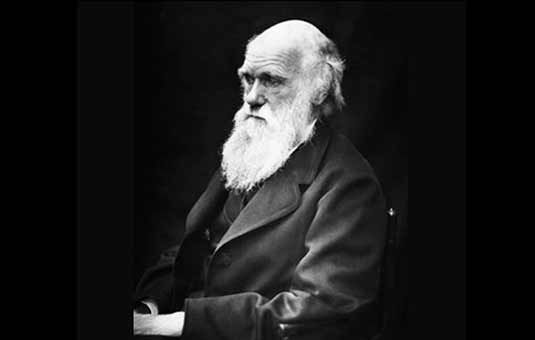
Charles Darwin in the Galapagos
Perhaps our offset association with the discussion "Galapagos" is the name "Darwin." Darwin's visit to the Galapagos Islands had a resounding impact on the formation of his Theory of Natural Choice.
A rather unmotivated and failing medical scholar, Charles Darwin accompanied Helm Robert Fitzroy equally a travel companion and naturalist on the HMS Beagle. His book the Voyage of the Beagle is an business relationship of his worldwide journeying.
When setting off from England in 1831 for a five-year voyage, Darwin had little ambitions for groundbreaking scientific enquiry. Subsequently surveying the coasts of Southward America, the ship stopped over in the Galapagos Islands.
During his visit to the islands, Darwin noted that the unique creatures were similar from island to isle, but perfectly adjusted to their environments which led him to ponder the origin of the islands' inhabitants.
Among those that struck Darwin so greatly were the finches that are at present named in his honor. Darwin would after base some of his idea from the supposing that these finches were all descendents of the same lineage.
Years later in 1859, Darwin finally consolidated all of his observations into his famous book On The Origin of Species, drastically and controversially altering the scientific view on the biological origins of life.
Follow in Darwin's Footsteps
Timeline of Darwin's voyage in the Galapagos
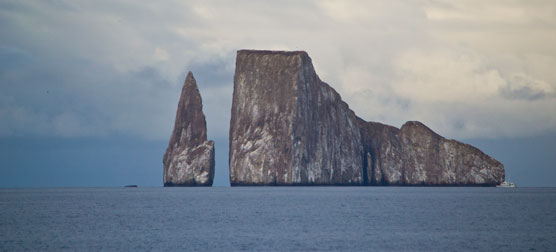
September 15-23, 1835: San Cristóbal Island (Chatham)
On September fifteen, Mount Pitt was sighted, on San Cristóbal Island.
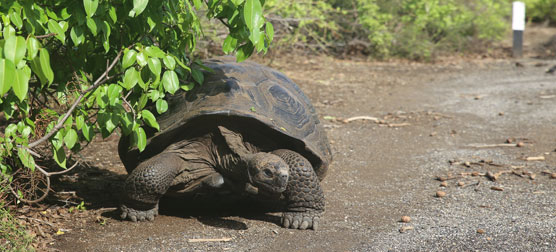
While the crew captured several of the San Cristobal giant tortoises for food, Charles Darwin was intrigued by the them and establish specimens on the islands, also as with the rocky island and the lava that formed information technology.
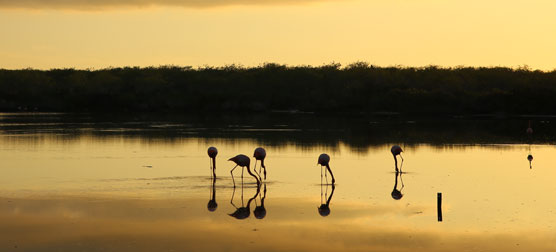
September 24-28: Floreana Island (Charles)
Floreana was an Ecuadorian penal colony while being managed by the Englishman, Nicholas Lawson and the Beagle's coiffure was allowed to get ashore for a tour of the colony.
Darwin diligently collected many brute and plant specimens and learned that information technology was possible to tell from which isle a tortoise came judging by its vanquish. In his journal, Darwin remarked that the convicts regularly ate tortoises and that whaling ships and pirates often took them: one such ship carried off 700 Floreana tortoises to eat while at sea. By 1846 the race was extinct.
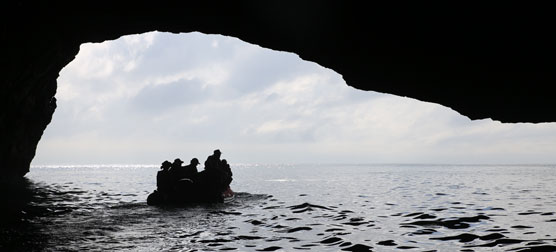
September 28-October 4: Isabela Island (Albemarle)
On this island, Darwin was amazed past the number of marine iguanas that fodder underwater.
His outset idea was that the iguana fed of fish and piddling animals. However, and while on James Isle, a autopsy of a marine iguana led to the discovery that they feed off algae.
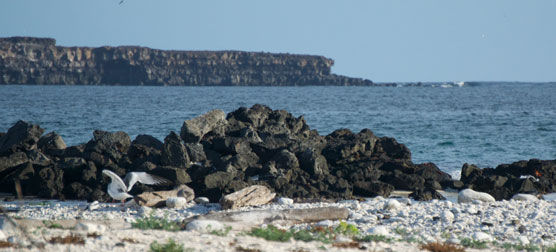
Oct 4 – Oct 8 - Northern Islands: Marchena, Genovesa, and Pinta (Bindloe, Tower, and Abingdon)
The Beagle tried to get to Abingdon Isle but was repeatedly foiled past currents and winds. It did non anchor at any of these islands and instead decided to head for James (Santiago) Isle, equally they were running low on fresh water.
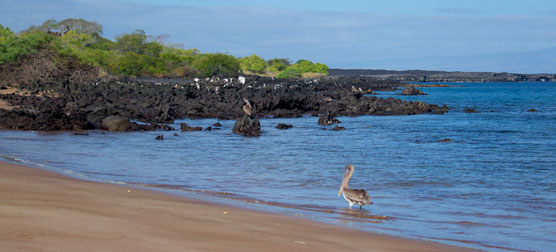
October 8 – Oct 17 - James (Santiago) Isle
The Beagle institute no water on James and headed back to Chatham to resupply.
Darwin, the ship's medico Benjamin Bynoe and each of their servants remained behind with a tent and provisions to spend the week exploring and gathering samples. They collected many specimens, including:
- Some fish
- Snails
- Several varieties of birds
- Reptiles
- Some insects, although he remarked about how few insects were to exist had.
It was virtually this time that Darwin realized that the unlike islands were home to different species.
October 17 – Oct 20 - Isabela (Albemarle), Wolf (Wenham) and Darwin (Culpepper) Islands
After picking upwardly Darwin's party, the Beagle went back to survey the eastern coast of Isabela Island before going to Abingdon (Pinta) to pick upward another political party that had been surveying in one of the smaller boats.
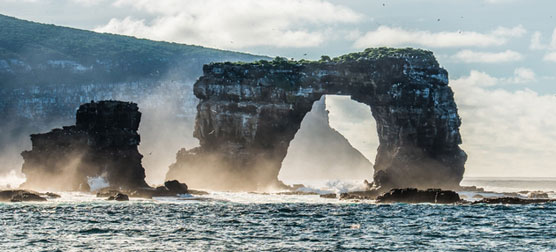
On October 20, they surveyed Wenham (Wolf) and Culpepper (Darwin) before setting sail for Tahiti:
Fast fact: Darwin never gear up foot on Culpepper, the Isle that at present bears his proper name.
Charles Darwin, Galapagos and "The Origin of Species"
The proper noun of Charles Darwin and his famous book The Origin of Species will forever be linked with the Galapagos Islands. Although he was just in the Galapagos for 5 weeks in 1835, it was the wildlife that he saw there that inspired him to develop his Theory of Evolution.
Merely how much of Galapagos actually made information technology into his controversial volume?
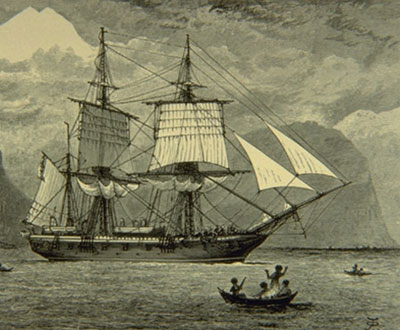
Proof of Darwin existence Inspired by the Galapagos:
In affiliate two of The Origin of Species, Darwin claims that information technology was his visit to the Galapagos that helped inspire his theories.
"Many years ago, when comparing, and seeing others compare, the birds from the separate islands of the Galapagos Archipelago, both 1 with another, and with those from the American mainland, I was much struck how entirely vague and arbitrary is the distinction between species and varieties."
-Charles Darwin
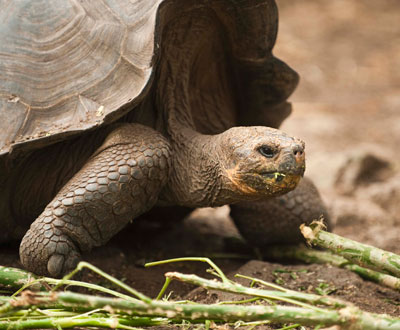
Endemism
The thought of owned species (species found only in i specific place and nowhere else on globe) was central to Darwin's arguments. The Galapagos Archipelago was key for him to prove his point:
"This fact might have been expected on my theory for, every bit already explained, species occasionally arriving afterward long intervals in a new and isolated district, and having to compete with new associates, will be eminently liable to modification, and will oft produce groups of modified descendants."
In other words, the owned species that had evolved on remote islands proved his point every bit they adjusted over long periods of time to a new environment, leaving backside their original characteristics.
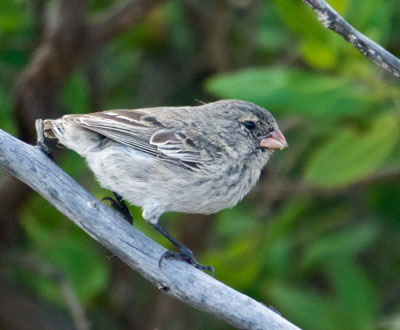
Darwin's Finches
Surprisingly, Darwin does not dwell on his famous finches much in The Origin of Species.
His earlier journal, Voyage of the Beagle, however, shows the crucial part these finches played in his theories. He stated:
"The remaining land-birds form a almost singular group of finches, related to each other in the construction of their beaks, short tails, a form of body and plumage."
"There are 13 species, which Mr. Gould has divided into iv subgroups. All these species are peculiar to this archipelago; and and so is the whole group, with the exception of i species of the sub-group Cactornis, lately brought from Bow Island, in the Low Archipelago."
-Charles Darwin
He later summarized his interpretation of the nature of these finches.
"Seeing this gradation and multifariousness of structure in one pocket-sized, intimately related group of birds, 1 might actually fancy that from an original paucity of birds in this archipelago, one species had been taken and modified for unlike ends."

You can follow in the steps of Darwin via cruise, personalized isle-hopping, or a combination of both. Enquire us well-nigh following Charles Darwin's footsteps and visiting some, or most of the islands he got his inspirations from.
Source: https://www.galapagosislands.com/info/history/charles-darwin.html
Posted by: ybanezdiestlyped1957.blogspot.com
0 Response to "What Were 3 Animals Darwin Studied While In The Galapagos Islands?"
Post a Comment